When it comes to choosing a multimeter, you might have come across the terms 2000 count and 4000 count. But what do these numbers really mean for you and your work?
Picking the right multimeter can make a big difference in accuracy, ease, and confidence while measuring electrical values. You’ll discover the key differences between 2000 count and 4000 count multimeters, helping you make a smart choice that fits your needs perfectly.
Ready to find out which one will give you the best results every time? Keep reading!
Credit: connectorsupplier.com
Basics Of Multimeter Counts
Understanding the basics of multimeter counts helps you choose the right tool. Counts show how detailed the multimeter’s reading can be. This affects how well you can measure voltage, current, or resistance.
Knowing these basics makes it easier to pick between a 2000 count and a 4000 count multimeter. Each has strengths depending on your needs. Let’s explore what counts mean and why they matter.
What Counts Mean
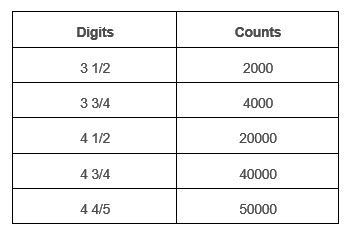
Counts tell how many numbers the multimeter can display. A 2000 count meter shows values up to 1999. A 4000 count meter goes up to 3999. More counts mean more steps between measurements.
This lets you see smaller changes in your readings. For example, a 4000 count meter can show 0.1 volts on a 400-volt scale. A 2000 count meter might only show 0.2 volts on the same scale.
Impact On Measurement Range
Counts define the maximum number the display can show. Higher counts mean wider measurement ranges without changing the scale. This reduces the need to switch settings often.
With more counts, you can measure fine details in higher ranges. This is useful for complex circuits or sensitive electronics. Lower counts may limit your ability to see those details clearly.
Role In Accuracy
Counts affect how precise the multimeter’s readings are. More counts allow the meter to show smaller differences. This helps in getting a more exact measurement.
Accuracy depends on counts and the meter’s quality. A 4000 count meter generally gives better precision than a 2000 count meter. This is important when small changes matter in your work.

Credit: www.railstudio.gr
Features Of 2000 Count Multimeters
2000 count multimeters are common tools used by many electricians and hobbyists. They offer basic features needed for simple electrical measurements. These multimeters can measure voltage, current, and resistance with decent accuracy. Their design focuses on ease of use and affordability.
They provide a good balance between functionality and cost. Many users rely on them for everyday tasks and quick checks. Understanding their features helps decide if they fit your needs.
Typical Uses
2000 count multimeters work well for household repairs and simple electronics. They measure battery voltage, check fuses, and test power outlets. DIY enthusiasts use them to troubleshoot small appliances. These multimeters suit tasks that do not require high precision.
Accuracy Limits
The accuracy of 2000 count multimeters is enough for general use. They usually have a resolution of 0.1% to 1%. This means small changes in voltage or current might not show clearly. For very detailed work, higher count multimeters are better. Still, 2000 count models give reliable results for most jobs.
Cost And Availability
These multimeters are affordable and easy to find. Many brands offer models under a low price point. They are available in hardware stores and online shops. This makes them a popular choice for beginners and budget users. Their low cost does not mean poor quality, just simpler features.
Features Of 4000 Count Multimeters
4000 count multimeters offer more advanced features than 2000 count models. They provide better accuracy and can measure a wider range of values. This makes them useful for more detailed and precise electrical work. Understanding their features helps choose the right tool for your tasks.
Enhanced Precision
4000 count multimeters show readings with greater detail. They display four digits instead of three. This means they can detect smaller changes in voltage or current. Better precision helps avoid mistakes in sensitive measurements. It is important for electronics and repair work.
Extended Measurement Range
These multimeters measure higher values compared to 2000 count models. They can handle larger voltages and currents safely. This wider range suits more types of electrical projects. Users can test household circuits and automotive parts with one device. It adds convenience and flexibility.
Price Considerations
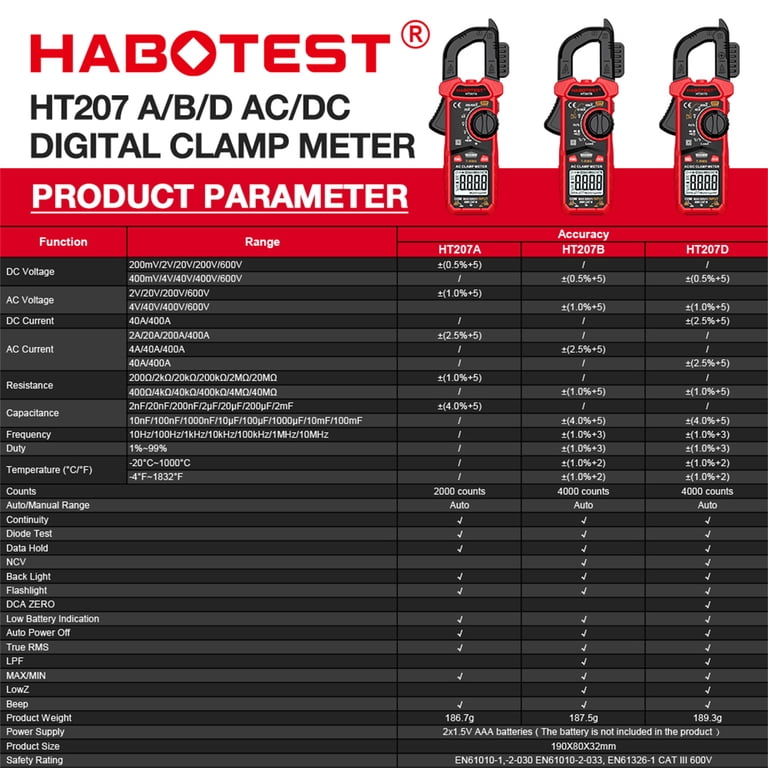
4000 count multimeters usually cost more than 2000 count ones. The extra price pays for improved accuracy and features. For simple tasks, a 2000 count multimeter might be enough. If detailed work is common, investing in a 4000 count model is wise. Balance your budget with your needs carefully.
Credit: www.walmart.com
Accuracy Comparison
Comparing the accuracy of 2000 and 4000 count multimeters shows clear differences. Accuracy impacts how well the device measures electrical values. This section breaks down these differences for better understanding.
Resolution Differences
2000 count multimeters show up to 1999 units on display. 4000 count models display up to 3999 units. Higher resolution means smaller changes are easier to detect. This makes 4000 count meters more precise in readings.
Real-world Performance
Accuracy affects how well the meter works on real circuits. 4000 count meters catch small voltage or current changes better. 2000 count meters may miss tiny variations. For detailed work, 4000 count offers better reliability.
User Experience
Users notice clearer readings with 4000 count meters. It reduces guesswork and improves confidence in results. 2000 count meters work fine for basic tasks. For advanced users, higher count multimeters enhance measurement clarity.
Choosing Between 2000 And 4000 Count
Choosing between a 2000 count and a 4000 count multimeter depends on your specific needs. The count number shows how many digits the meter can display. A higher count means more precise readings. This choice affects your measurements and overall satisfaction with the device.
Application Needs
Consider what you will measure most often. A 2000 count multimeter works well for basic tasks. It can handle simple voltage, current, and resistance checks. For detailed projects or small measurements, a 4000 count model is better. It provides finer resolution and more accuracy.
If you work with electronics or need precise data, choose 4000 count. For general home use or quick checks, 2000 count is enough. Match the multimeter to your daily tasks for best results.
Budget Factors
Price is important when picking a multimeter. Models with 2000 count usually cost less. They fit well for hobbyists or beginners. A 4000 count meter costs more due to better features and accuracy.
Think about how much you want to spend. Avoid paying extra if you don’t need high precision. Spend wisely based on your use and budget limits. This helps you get the right tool without overspending.
Long-term Value
Look at the multimeter as an investment. A 4000 count meter lasts longer for growing needs. It adapts to more types of jobs as skills improve. The extra cost pays off over time with wider use.
A 2000 count meter is fine for simple tasks but may need replacement sooner. Choose a model that grows with your work. This saves money and avoids buying multiple meters later.
Common Misconceptions
Many people confuse the features of 2000 count and 4000 count multimeters. This leads to wrong choices and expectations. Understanding common misconceptions helps pick the right tool for your needs.
Multimeter counts show the device’s resolution. But higher counts do not always mean better performance. Other factors matter too.
Higher Count Always Better?
People often think 4000 count is always better than 2000 count. The truth is, higher count means finer reading detail. It shows smaller changes in measurements.
For basic tasks, 2000 count is enough. It gives accurate readings for most home and simple electrical works. A 4000 count is useful for precise and advanced measurements only.
Impact On Durability
Some believe a higher count multimeter breaks easier. The count does not affect the build quality. Durability depends on brand, design, and materials used.
A 2000 count multimeter can be as tough as a 4000 count one. Look for shockproof cases and good protection features. These help the tool last longer.
Effect On Speed
Many assume 4000 count multimeters work slower. Higher count can slightly slow down reading updates. This is due to more data processing.
This difference is small and usually not noticeable for most users. Speed depends more on the device’s processor than just count. Both types give quick readings for everyday use.
Tips For Maximizing Multimeter Accuracy
Using a multimeter accurately is key to getting the best readings. Small errors can lead to wrong results and confusion. This section shares easy tips to keep your multimeter readings precise and reliable. Follow these steps to improve your device’s accuracy and extend its life.
Proper Calibration
Calibration ensures your multimeter shows correct values. Check calibration regularly, especially before important tests. Use a known reference voltage or resistance for comparison. Adjust settings as needed to match the reference. Keep a record of calibration dates and results. Proper calibration prevents errors and boosts trust in your readings.
Maintenance Practices
Clean your multimeter often to avoid dirt buildup. Dust and moisture can affect the device’s sensors. Store it in a dry, safe place after use. Replace batteries as soon as they run low. Worn test leads should be swapped out quickly. Good maintenance keeps your multimeter working well and accurate.
Best Usage Techniques
Hold the probes steadily to avoid unstable readings. Use the correct range setting for the measurement type. Avoid touching metal parts of the probes during tests. Take multiple readings and average them for better accuracy. Disconnect power before measuring resistance or continuity. Smart usage helps get reliable and clear results from your multimeter.
Frequently Asked Questions
What Is The Main Difference Between 2000 And 4000 Count Multimeters?
The main difference is display resolution. A 2000 count shows up to 1999, while a 4000 count shows up to 3999. Higher counts provide more precise readings and better measurement accuracy.
Which Multimeter Count Is Better For Beginners?
A 2000 count multimeter is ideal for beginners. It offers simpler readings and is easier to use. For basic electrical tasks, it provides sufficient accuracy without overwhelming new users.
How Does Count Affect Multimeter Accuracy?
Higher counts improve resolution and accuracy. A 4000 count multimeter can detect smaller changes in voltage or current. This means measurements are more precise compared to a 2000 count model.
Is A 4000 Count Multimeter Worth The Extra Cost?
Yes, if you need precise measurements. The 4000 count model offers better detail and accuracy. For professionals or detailed diagnostics, the extra cost is justified.
Conclusion
Choosing between a 2000 and 4000 count multimeter depends on your needs. The 4000 count offers more detail and accuracy. The 2000 count works well for basic tasks. Both types measure voltage, current, and resistance. Think about the projects you will do most.
A higher count helps with precise readings. A lower count saves money and is easy to use. Pick the multimeter that fits your skill and budget. Simple tools can still get the job done well.

I’m Asif Ur Rahman Adib, an Electrical Engineer and lecturer. My journey began in the lab, watching students struggle with instruments they used every day without fully understanding them. Over time, I’ve combined teaching, research, and hands-on experience to help others grasp electrical concepts clearly, safely, and practically—whether it’s understanding a circuit or mastering a multimeter.