Are you struggling to choose between a logic analyzer and an oscilloscope for your electronic projects? Both tools look similar but serve very different purposes.
Understanding which one fits your needs can save you time, money, and frustration. You’ll discover the key differences, strengths, and weaknesses of each device. By the end, you’ll know exactly which tool will give you the edge in troubleshooting and analyzing your circuits.
Keep reading—your next breakthrough could depend on it.
Key Features Of Logic Analyzers
Logic analyzers offer several key features that make them essential for digital circuit testing. These features help engineers see and understand digital signals clearly. They provide detailed data about how signals change over time. This helps find problems in complex circuits quickly and accurately.
Signal Capture And Timing Analysis
Logic analyzers capture multiple digital signals at once. They record signals over time to show how they interact. Timing analysis checks signal delays and timing errors. This helps ensure circuits work as designed. Capturing many signals simultaneously is a big advantage over oscilloscopes.
Triggering And Decoding Capabilities
Triggers help start data capture on specific events. This makes it easier to find rare or complex problems. Logic analyzers decode protocols like I2C, SPI, and UART. Decoding shows data in readable form. This saves time and reduces errors in analysis.
Data Storage And Processing
Logic analyzers store large amounts of captured data. This allows detailed review and comparison later. They process data to highlight issues and patterns. This helps engineers focus on important signals. Built-in analysis tools make debugging faster and more effective.
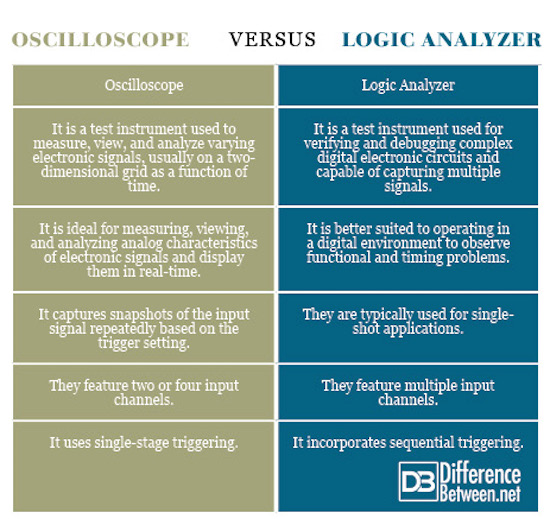
Credit: www.differencebetween.net
Key Features Of Oscilloscopes
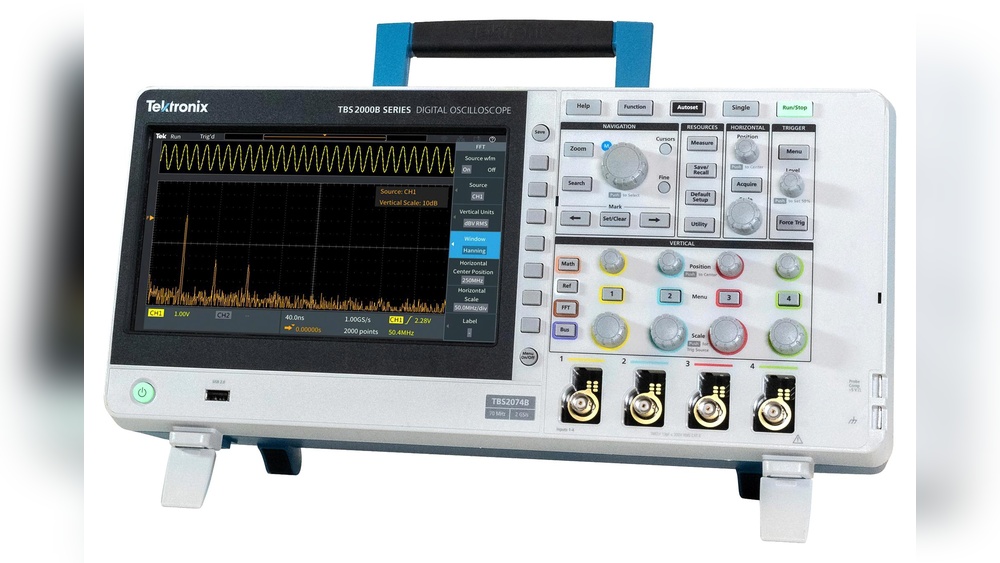
Oscilloscopes are essential tools for anyone working with electronic signals. They help visualize how signals change over time. Understanding their key features helps users choose the right tool for their needs. These features define how well an oscilloscope performs in capturing and analyzing signals.
Waveform Visualization
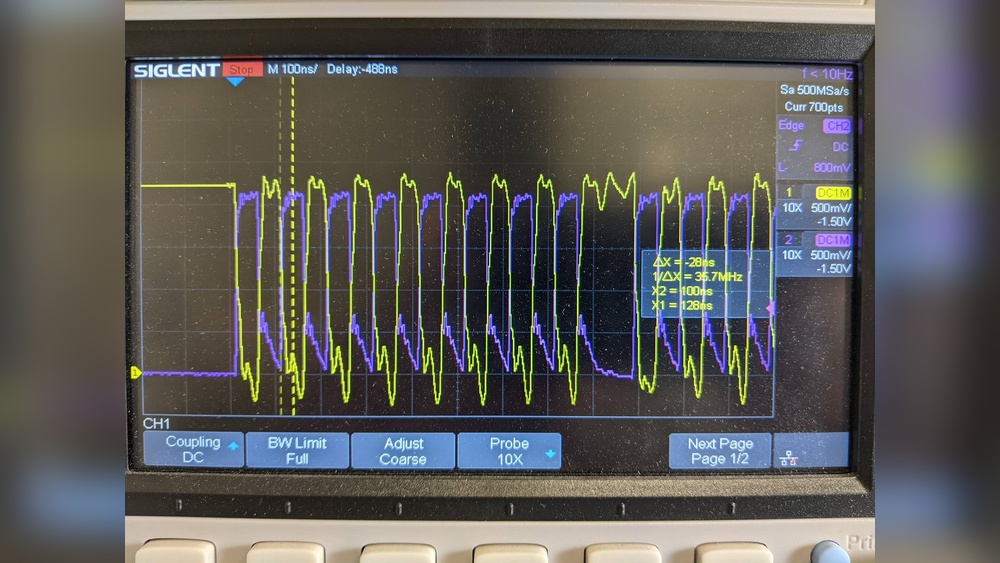
Oscilloscopes display waveforms as graphs of voltage against time. This visualization shows signal shape, frequency, and amplitude clearly. Users can see changes instantly and detect signal problems. The screen updates in real-time, making it easy to watch signals live. Color displays often highlight different signals for better clarity.
Bandwidth And Sample Rate
Bandwidth is the highest frequency an oscilloscope can measure accurately. Higher bandwidth means it can capture fast signals without distortion. Sample rate refers to how often the oscilloscope records data points per second. Faster sample rates provide more detail in the waveform. Both factors are crucial for capturing precise signal information.
Measurement And Analysis Tools
Oscilloscopes include built-in tools for measuring signal properties. These tools can calculate voltage levels, frequency, and timing intervals automatically. Many models offer advanced analysis like FFT to view signal frequency components. These features save time and reduce errors in manual calculations. Users can set triggers to capture specific events in signals.
Applications In Electronics Testing
Testing electronics requires different tools for different tasks. Logic analyzers and oscilloscopes each serve unique roles. Both help engineers find faults and verify designs. Understanding their applications in electronics testing clarifies which tool fits best.
Digital Circuit Debugging
Logic analyzers excel at digital circuit debugging. They capture multiple digital signals at once. This helps trace timing and logic problems easily. Engineers use them to check microcontrollers and digital buses. They reveal how digital signals change over time.
Analog Signal Inspection
Oscilloscopes are ideal for analog signal inspection. They show voltage changes continuously on a screen. This makes it easy to spot noise, distortion, or spikes. Engineers use oscilloscopes to analyze audio signals or power supplies. They provide a clear view of wave shapes.
Mixed-signal Testing
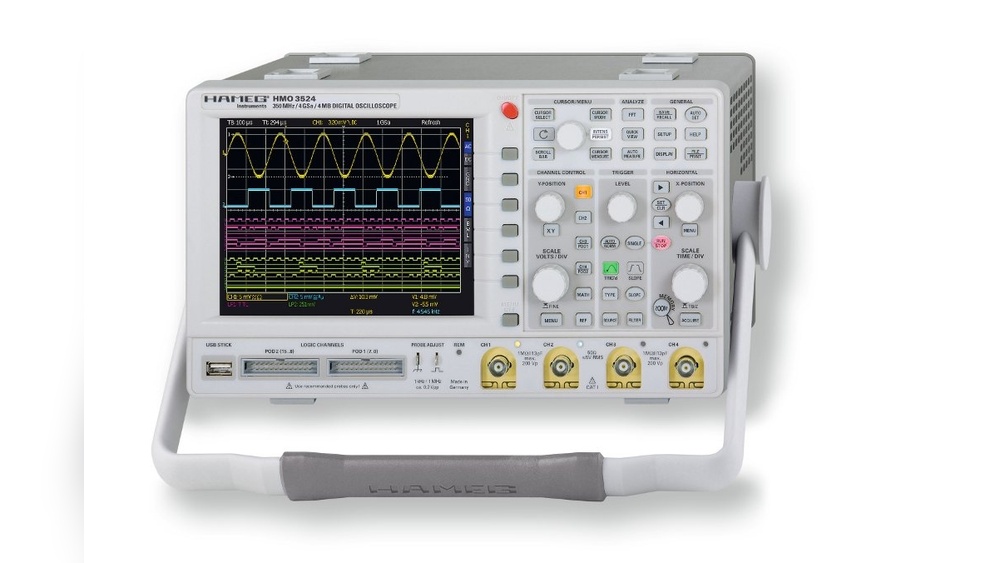
Mixed-signal testing combines digital and analog signals. Some devices handle both logic analyzers and oscilloscopes. These tools allow simultaneous capture of digital and analog data. Engineers verify how signals interact in complex circuits. This ensures proper functioning of mixed-signal devices.
Advantages Of Logic Analyzers
Logic analyzers offer many benefits over oscilloscopes for digital signal testing. They are designed for detailed digital circuit analysis. These tools help engineers and technicians understand complex digital signals effectively.
Logic analyzers provide clear insights into digital data. They capture multiple signals at once and decode data protocols. This makes debugging faster and more accurate.
Complex Digital Signal Analysis
Logic analyzers handle complex digital signals easily. They capture data from many points simultaneously. This allows users to see how signals interact in real time. They detect subtle timing issues that oscilloscopes may miss.
Multi-channel Monitoring
Logic analyzers support many channels at once. Users can monitor dozens or even hundreds of digital lines. This wide coverage helps track all signals in a system. It is very useful for testing large digital circuits or microcontrollers.
Protocol Decoding Support
Logic analyzers decode common digital protocols automatically. They recognize signals like I2C, SPI, UART, and more. This saves time by showing decoded data directly. Users do not need to interpret raw waveforms manually.
Advantages Of Oscilloscopes
Oscilloscopes offer several clear benefits for electronic testing and measurement. They excel at showing signal behavior in a simple and direct way. These tools help engineers and hobbyists understand circuits by visualizing electrical signals over time.
Oscilloscopes provide detailed views of electrical signals, making them ideal for many tasks. Their ability to display real-time waveforms and handle high-frequency signals gives them an edge in many applications. They also offer flexible measurement options that suit various testing needs.
High-frequency Signal Capture
Oscilloscopes can capture signals with very high frequencies. This ability helps catch fast changes in electronic circuits. It is useful for testing radio frequency devices and digital electronics that operate at high speeds. The precise timing of signals is visible, which helps with accurate analysis.
Real-time Waveform Display
Oscilloscopes show waveforms in real-time on their screens. This feature allows users to see how signals change instantly. It is easier to spot problems or unexpected behavior in circuits. Watching signals live helps with troubleshooting and tuning electronic devices quickly.
Versatile Measurement Options
Oscilloscopes offer many measurement tools built into their systems. Users can measure voltage, frequency, rise time, and more with ease. Different probe types and settings allow testing a wide range of signals. This versatility makes oscilloscopes useful in many fields and projects.

Credit: www.batterfly.com
Limitations To Consider
Choosing between a logic analyzer and an oscilloscope requires understanding their limits. Each tool has strengths but also clear constraints. Knowing these helps pick the right device for your project needs.
Logic Analyzer Constraints
Logic analyzers capture digital signals only. They cannot measure analog signals. This limits their use in mixed-signal circuits. They often need many channels to track complex systems. More channels mean higher cost and complexity.
Timing accuracy depends on the device’s sample rate. Low sample rates miss fast signal changes. Logic analyzers may not show signal voltage levels. This makes it hard to detect signal quality issues.
Oscilloscope Challenges
Oscilloscopes mainly display analog waveforms. Digital signal analysis can be difficult or limited. They usually have fewer input channels than logic analyzers. This restricts simultaneous multi-signal observation.
High-frequency signals need scopes with fast bandwidth. Lower bandwidth scopes distort or miss details. Oscilloscopes may struggle with long capture times. They store less data compared to logic analyzers.
Choosing The Right Tool
Choosing the right tool between a logic analyzer and an oscilloscope can shape your project’s success. Each device serves unique purposes and fits different needs. Understanding these differences helps you pick the best option.
Project Requirements
Identify what your project demands first. If you need to analyze digital signals and timing, a logic analyzer fits best. For viewing analog waveforms and signal shapes, an oscilloscope is ideal. Consider the signal type and complexity before deciding.
Budget And Features
Set a clear budget for your purchase. Logic analyzers often cost more due to advanced digital features. Oscilloscopes vary widely in price, depending on bandwidth and channels. Compare features within your budget to get the most value.
Ease Of Use And Portability
Think about how easy the tool is to operate. Oscilloscopes usually have simpler interfaces and quick setup. Logic analyzers might require more learning but offer detailed data. Also, check the size and weight if you need to move the device often.
Future Trends In Signal Analysis
Signal analysis tools like logic analyzers and oscilloscopes are evolving fast. New technologies are changing how engineers and technicians work. These tools will become smarter, easier to use, and more connected. Let’s explore the key trends shaping their future.
Integration Of Ai And Automation
Artificial intelligence is helping signal analyzers detect issues faster. AI can spot patterns and errors that humans might miss. Automation reduces manual work, speeding up tests and analysis. This means fewer mistakes and more reliable results. AI also helps in predicting problems before they occur.
Improved User Interfaces
Future devices will have simpler and clearer screens. Touch controls and easy menus will make tools friendlier. Visuals will guide users step-by-step through tests. This helps beginners and saves time for experts. Clear interfaces reduce confusion and improve accuracy.
Enhanced Connectivity Options
Signal analyzers will connect easily to other devices and networks. Wireless and cloud connections let users share data quickly. Remote access allows troubleshooting from anywhere in the world. This flexibility supports teamwork and speeds up projects. Data syncing also helps keep records organized and safe.

Credit: articles.saleae.com
Frequently Asked Questions
What Is The Main Difference Between A Logic Analyzer And Oscilloscope?
A logic analyzer captures digital signals and timing relationships. An oscilloscope displays analog waveforms and voltage changes. Both tools serve different purposes in electronics debugging and testing.
When Should I Use A Logic Analyzer Over An Oscilloscope?
Use a logic analyzer for digital circuit analysis and timing issues. Choose an oscilloscope for analog signals and waveform visualization. Each tool fits specific testing needs.
Can An Oscilloscope Measure Digital Signals Effectively?
Oscilloscopes can measure digital signals but lack deep timing analysis. Logic analyzers provide better insight into digital data streams and protocols. Select tools based on signal complexity.
Are Logic Analyzers Suitable For Analog Signal Testing?
No, logic analyzers cannot test analog signals. They focus on digital logic states and timing. Oscilloscopes are the preferred choice for analog measurements.
Conclusion
Both logic analyzers and oscilloscopes help you see electrical signals clearly. Logic analyzers show digital signals and timing well. Oscilloscopes display analog signals with smooth curves. Choose based on your project’s needs and signal type. Understanding their strengths helps you work smarter and faster.
Each tool fits different tasks and skills. Use them wisely to solve problems and learn more about circuits. Simple tools, big help.

I’m Asif Ur Rahman Adib, an Electrical Engineer and lecturer. My journey began in the lab, watching students struggle with instruments they used every day without fully understanding them. Over time, I’ve combined teaching, research, and hands-on experience to help others grasp electrical concepts clearly, safely, and practically—whether it’s understanding a circuit or mastering a multimeter.