
Understanding What Matters When Choosing Between Rigol Dho804 Vs Siglent Sds804
Buying a lab oscilloscope is often about finding the right balance between features, ease of use, and reliability. Both Rigol DHO804 and Siglent SDS804X HD offer 70 MHz bandwidth and 12-bit resolution, but they differ in size, weight, and some advanced capabilities. You want to avoid regrets related to portability, interface, or future software needs. Consider where and how you’ll mostly use the device. Also, think about the level of support and remote control options you might need. This helps narrow down the choice beyond just specs.
Who Typically Considers Rigol Dho804 Vs Siglent Sds804
- Electronics researchers needing precise signal capture.
- Lab technicians who value a compact and portable design.
- Engineers requiring advanced protocol decoding.
- Users who want a touchscreen interface for quick navigation.
- Those who use oscilloscopes for field diagnostics and remote control.
- Buyers prioritizing a richer set of data analysis features.
Where Rigol Dho804 Stands Out
If you need a portable oscilloscope with a clear touchscreen, Rigol’s DHO804 fits well. I appreciate its USB-C power input with power bank support, making it handy for on-site work without worrying about power outlets.
This model blends a simple interface with advanced measurement tools. The Android OS and remote control options also make it flexible for deeper programming or PC integration.
.ap-btn{ transition:transform .15s ease, filter .15s ease; } .ap-btn:hover{ transform:translateY(-1px); filter:brightness(.95); }
Strengths That Help You Feel Confident
- High 12-bit resolution with low noise for precise signal capture.
- Portable design with USB-C power input and power bank support.
- Built-in multimeter and frequency counter expand functionality.
- Supports protocol decoding for several common serial protocols.
- Remote control and secondary development support via Android OS.
Considerations That Could Affect Satisfaction
- Weight is lighter, but screen size is limited to 7 inches.
- Sampling rate is capped at 1.25 GSa/s, which may be limiting for some high-speed signals.
When Siglent Sds804x Hd Might Be The Better Fit
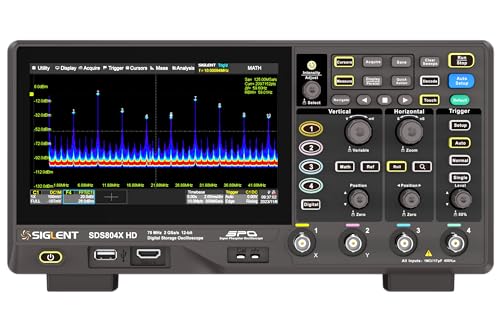
I find Siglent’s SDS804X HD attractive if I need more advanced math functions and higher sampling rates. It offers a bit more in data analysis and signal processing flexibility.
The bigger footprint and weight may be less ideal for portability, but it compensates with a larger, high-res display and deeper memory.
Features That Support In-Depth Analysis
- Sample rate up to 2 GSa/s for better signal detail.
- 70 μVrms noise floor for cleaner signal acquisition.
- Rich data analysis tools including Bode plot and power analysis.
- Supports 4 math traces and formula editor for custom calculations.
- 7” TFT-LCD with 1024×600 resolution for clearer waveform display.
Factors That May Limit Use
- Heavier and larger, less suited for frequent transport.
- Does not offer the same remote control or Android OS features as Rigol.
Key Questions That Help Narrow Down Your Choice
How important is portability? If you need to carry your oscilloscope often, weight and power options matter. The Rigol model is lighter and supports power banks.
Do you require advanced math and signal analysis functions? Siglent offers a richer set of analysis tools and a higher sampling rate.
Will you use remote control or integrate with custom software? Rigol’s Android OS and SCPI compatibility may be a plus.
How much does screen size and clarity affect your daily work? Siglent’s larger and higher resolution display might ease waveform review.
Consider also the physical size and workspace available. Siglent’s model is bulkier.
Comparing Rigol Dho804 And Siglent Sds804x Hd Side By Side
Portability and Design
Smaller and lighter models are easier to move and set up.
| Decision factor | Rigol DHO804 | Siglent SDS804X HD |
|---|---|---|
| Weight | 3.9 Pounds | 8.4 Pounds |
| Dimensions (H×W×L) | 6.4″ × 3.0″ × 10.4″ | 5.25″ × 6.0″ × 12.3″ |
| Power Input | USB-C with power bank support | Standard power input |
| Screen Size | 7-inch HD touchscreen | 7-inch TFT-LCD, 1024×600 |
| Color | Red | Grey |
This matters most for users who need frequent mobility or have limited workspace.
Sampling and Signal Capture
The clarity and speed of signal capture affect analysis quality.
| Decision factor | Rigol DHO804 | Siglent SDS804X HD |
|---|---|---|
| Sampling Rate | 1.25 GSa/s | 2 GSa/s |
| Memory Depth | 25 Mpts | 50 Mpts per channel |
| Noise Floor | Low-noise design | 70 μVrms noise floor |
| Resolution | 12-bit ADC | 12-bit ADC |
This difference is key if you work with very fast or complex signals.
Features and Usability
Extra tools and control options influence long-term usability.
| Decision factor | Rigol DHO804 | Siglent SDS804X HD |
|---|---|---|
| Protocol Decoding | RS232/UART, I2C, SPI, CAN | Not specified |
| Math Functions | Basic FFT and automatic measurements | 4 math traces, formula editor |
| Remote Control | Yes, via Android OS | No |
| Data Analysis | FFT analysis | Search, Navigate, Counter, Bode plot, Power Analysis |
Those who value advanced math and analysis tools may prefer the Siglent.
Thinking Ahead To Avoid Second-guessing Your Choice
Consider whether the oscilloscope will keep up with your evolving needs. If you expect to work with more complex protocols or require remote access, Rigol’s features could be essential. On the other hand, if your work demands higher sampling rates and richer math functions, Siglent may prevent frustration later.
Portability is another common regret point. The heavier Siglent can be cumbersome for fieldwork. Make sure your workspace can accommodate the larger size.
Finally, think about how much you rely on touchscreen or interface ease. The Android OS and touch controls on Rigol may reduce learning curves or operational errors.
Finding A Balanced Decision Between Rigol Dho804 Vs Siglent Sds804
Both oscilloscopes serve well in typical lab settings, but the best choice depends on your specific priorities. If portability, remote control, and protocol decoding are vital, Rigol DHO804 is a thoughtful pick. For deeper analysis, larger display, and faster sampling, Siglent SDS804X HD offers strong advantages.
Spend time considering how each fits your daily workflow and future projects. This reduces risks of dissatisfaction and wasted investment.
Ultimately, either model can serve well when matched thoughtfully to your needs.
Frequently Asked Questions About Rigol Dho804 Vs Siglent Sds804
Which model is easier to carry for field work?
The Rigol DHO804 is lighter and more compact, making it easier for on-site diagnostics. It also supports USB-C power input with power bank use.
Do both oscilloscopes support advanced protocol decoding?
Rigol DHO804 supports several protocols like RS232/UART, I2C, SPI, and CAN. Siglent SDS804X HD does not specify protocol decoding features.
Which oscilloscope offers higher sampling rates?
Siglent SDS804X HD has a sampling rate up to 2 GSa/s, higher than Rigol DHO804’s 1.25 GSa/s. This benefits capturing fast signals.
Can I control these oscilloscopes remotely?
The Rigol DHO804 runs Android OS and supports remote control via USB and LAN. The Siglent SDS804X HD lacks this remote control capability.
How do their screen displays compare?
Both have 7-inch screens, but Siglent’s TFT-LCD offers a higher resolution (1024×600). Rigol provides an HD touchscreen which some may find more intuitive.
Are there differences in weight and size?
Yes, Rigol is lighter at about 3.9 pounds versus Siglent’s 8.4 pounds. Siglent is also wider and longer, which might affect desk space.
Which oscilloscope is better for advanced math analysis?
Siglent SDS804X HD includes more math functions like multiple math traces and a formula editor, which are useful for complex signal processing.

I’m Asif Ur Rahman Adib, an Electrical Engineer and lecturer. My journey began in the lab, watching students struggle with instruments they used every day without fully understanding them. Over time, I’ve combined teaching, research, and hands-on experience to help others grasp electrical concepts clearly, safely, and practically—whether it’s understanding a circuit or mastering a multimeter.