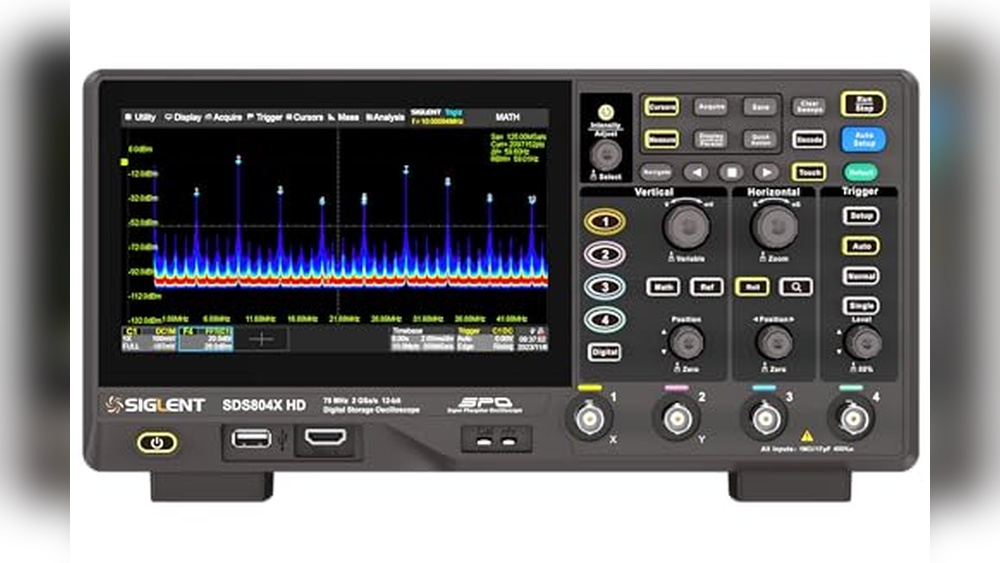
The Siglent SDS804X HD and the Rigol DHO804 are both lab oscilloscopes designed for electronics work. They offer similar bandwidth and channel counts but differ in sampling rates and extra features. The Siglent model emphasizes higher sample rate and memory depth, while the Rigol focuses on portability and multifunction tools.
The core difference lies in sample rate and additional built-in functions tailored for different user needs.
After reading, you will be able to decide which oscilloscope suits your daily electronics testing and development tasks better.
Quick Guidelines For Choosing Between These Lab Oscilloscopes
- Choose the Siglent 4-Channel 70 MHz Oscilloscope if you need a higher sample rate and deeper memory for detailed waveform analysis.
- Pick the Rigol 70MHz 12-bit Digital Oscilloscope when you want a portable unit with touchscreen and built-in multimeter for multifunction use.
- Go with Siglent for more extensive math trace options and data analysis features.
- Consider Rigol if remote control capability and protocol decoding support are priorities.
- Both oscilloscopes offer 4 analog channels and 70 MHz bandwidth, so channel count and bandwidth won’t limit most lab tasks.
Using These Oscilloscopes In Everyday Electronics Work
The Siglent 4-Channel 70 MHz Oscilloscope feels stable for detailed bench work. Its larger memory and higher sample rate let me capture complex signals with ease. The screen resolution and math functions help when analyzing power or frequency components.
The Rigol 70MHz 12-bit Digital Oscilloscope fits well in situations requiring portability. The touchscreen interface is intuitive, and built-in multimeter functions reduce the need for extra tools. It’s convenient for quick diagnostics and fieldwork thanks to USB-C power input and remote control features.
At A Glance: Siglent 4-channel 70 Mhz Oscilloscope

Where the Siglent Excels
- High sample rate of up to 2 GSa/s for detailed signal capture.
- Large memory depth of 50 Mpts per channel for long waveform storage.
- Multiple math trace options including FFT and formula editor.
- Good for advanced data analysis and power measurements.
- Solid build with a clear 7-inch TFT-LCD display.
Where the Siglent Can Be Challenging
- Heavier and larger compared to some portable models.
- Lacks touchscreen interface found in some competitors.
- Less suited for quick field diagnostics due to size and weight.
At A Glance: Rigol 70mhz 12-bit Digital Oscilloscope

Where the Rigol Stands Out
- Portable design with lightweight and compact size.
- 7-inch HD touchscreen for easy control and navigation.
- Built-in digital multimeter and frequency counter add versatility.
- Supports protocol decoding for common serial interfaces.
- Remote PC control and secondary development support via USB, LAN, and HDMI.
Where the Rigol Faces Limitations
- Lower maximum sample rate of 1.25 GSa/s compared to Siglent.
- Memory depth limited to 25 Mpts per channel.
- Less memory depth may affect long waveform captures.
- Red color and design may not suit all lab aesthetics.
Comparing Key Practical Features Of These Lab Oscilloscopes
In daily use, I compared how both oscilloscopes handled signal capture, ease of use, and additional features. The focus was on how sample rate and memory affect waveform details. Also considered were interface usability and portability for different work environments.
How Does Sampling Rate Affect Signal Detail?
Sampling rate defines how finely the oscilloscope captures signal changes. This influences the accuracy of waveform representation during analysis.
| Aspect | Siglent 4-Channel 70 MHz Oscilloscope | Rigol 70MHz 12-bit Digital Oscilloscope |
|---|---|---|
| Maximum Sample Rate | Up to 2 GSa/s | Up to 1.25 GSa/s |
| Signal Detail | Finer details captured at high speeds | Good for most signals but less detail at very high speed |
| Use Case | Better for detailed R&D and complex waveforms | Suitable for general lab and field tests |
Ratings: Siglent – 8/10 | Rigol – 7/10
Edge: Siglent suits users needing detailed signal capture better.
Is Memory Depth Important for Continuous Waveform Capture?
Memory depth affects how long and detailed a waveform can be recorded without gaps. This is crucial for analyzing long or complex signals.
| Aspect | Siglent 4-Channel 70 MHz Oscilloscope | Rigol 70MHz 12-bit Digital Oscilloscope |
|---|---|---|
| Memory Depth per Channel | 50 Mpts | 25 Mpts |
| Waveform Length | Longer continuous capture | Shorter capture duration |
| Practical Impact | Better for complex analysis requiring long records | Good for standard tests and quick captures |
| Memory Tradeoff | Requires more data handling capacity | Less demanding on storage |
Ratings: Siglent – 8/10 | Rigol – 7/10
Edge: Siglent offers an advantage for long-duration signal capture.
How Does User Interface Affect Everyday Use?
The ease of navigating menus and controlling measurements impacts efficiency and comfort in lab work.
| Aspect | Siglent 4-Channel 70 MHz Oscilloscope | Rigol 70MHz 12-bit Digital Oscilloscope |
|---|---|---|
| Screen Type | 7-inch TFT-LCD, non-touch | 7-inch HD touchscreen |
| Control Method | Buttons and knobs | Touch interface with gestures |
| User Experience | Traditional, stable interface | More intuitive for new users |
| Additional Features | Extensive math and formula editor | Built-in multimeter and protocol decoding |
Ratings: Siglent – 7/10 | Rigol – 8/10
Edge: Rigol fits users preferring touchscreen and multifunction tools.
How Important Is Portability and Power Options?
Portability matters for fieldwork and on-site diagnostics. Power input flexibility affects usability in different environments.
| Aspect | Siglent 4-Channel 70 MHz Oscilloscope | Rigol 70MHz 12-bit Digital Oscilloscope |
|---|---|---|
| Weight | 8.4 pounds | 3.9 pounds |
| Power Input | Standard AC power | USB-C with power bank support |
| Portability | Better for bench use | Better for portable and field use |
Ratings: Siglent – 6/10 | Rigol – 8/10
Edge: Rigol is a better fit for mobile and field applications.
Long-term Experience With These Lab Oscilloscopes
Learning to use the Siglent 4-Channel 70 MHz Oscilloscope involves understanding its extensive math and analysis features. It rewards consistent use with trust in detailed measurements. Over time, familiarity with its controls leads to peace of mind when working on complex signals.
The Rigol 70MHz 12-bit Digital Oscilloscope has a shorter learning curve due to its touchscreen and multifunction tools. It provides reliable performance for everyday diagnostics. Users gain confidence quickly and appreciate its flexibility in various lab and field settings.
Choosing The Right Oscilloscope For Your Lab Needs
If you need higher sample rates, deeper memory, and advanced math analysis for detailed research and development, the Siglent 4-Channel 70 MHz Oscilloscope is a solid choice. It is ideal for bench use where detailed waveform capture is essential.
The Rigol 70MHz 12-bit Digital Oscilloscope suits users valuing portability, touchscreen control, and multifunction instruments like a built-in multimeter. It works well for fieldwork and quick diagnostics with remote control features.
Both models deliver practical lab performance, so your choice depends on whether detailed analysis or versatile portability fits your workflow better.
Common Questions About Siglent Sds804x Hd Vs Rigol Dho804 Lab Oscilloscopes
Which oscilloscope is better for capturing fast signals?
The Siglent model offers a higher maximum sample rate of 2 GSa/s, allowing better capture of very fast signals. The Rigol’s 1.25 GSa/s is sufficient for many applications but less detailed at the highest speeds.
Can I use the Rigol oscilloscope for protocol decoding?
Yes, the Rigol DHO804 supports protocol decoding for RS232/UART, I2C, SPI, and CAN, which can improve efficiency when working with serial communications.
Is the Siglent oscilloscope portable enough for field use?
The Siglent unit is heavier and larger, making it less convenient for portable use compared to the Rigol. It is better suited for bench work in labs.
Does the Rigol oscilloscope have a touchscreen?
Yes, it features a 7-inch HD touchscreen, which simplifies navigation and control compared to traditional buttons and knobs.
How important is memory depth in these oscilloscopes?
Memory depth affects how long and detailed waveforms can be recorded. The Siglent offers 50 Mpts per channel, which is deeper than the Rigol’s 25 Mpts, benefiting complex and long-duration captures.
Can I control the Rigol oscilloscope remotely?
Yes, the Rigol supports remote control via USB, LAN, and HDMI connections, which can be useful for automated testing and development.
Are both oscilloscopes suitable for beginners?
The Rigol’s touchscreen and built-in multifunction features may be easier for beginners. The Siglent offers more advanced analysis but may require more time to learn fully.

I’m Asif Ur Rahman Adib, an Electrical Engineer and lecturer. My journey began in the lab, watching students struggle with instruments they used every day without fully understanding them. Over time, I’ve combined teaching, research, and hands-on experience to help others grasp electrical concepts clearly, safely, and practically—whether it’s understanding a circuit or mastering a multimeter.