When To Choose Each Fluke Digital Thermometer
- Pick Fluke 52 Dual Input for straightforward temperature monitoring without data logging.
- Choose Fluke 54 USB Recording when you need detailed data storage and PC export options.
- Go with Fluke 52 for basic industrial uses with broad temperature ranges.
- Prefer Fluke 54 if you want a backlit display and advanced logging features.
- Fluke 52 makes more sense for those who want a simple and reliable dual input meter.
- Fluke 54 is the safer bet for users needing precise data analysis and graphing.
Does The Fluke 52 Dual Input Thermometer Handle Diverse Temperature Ranges Well?
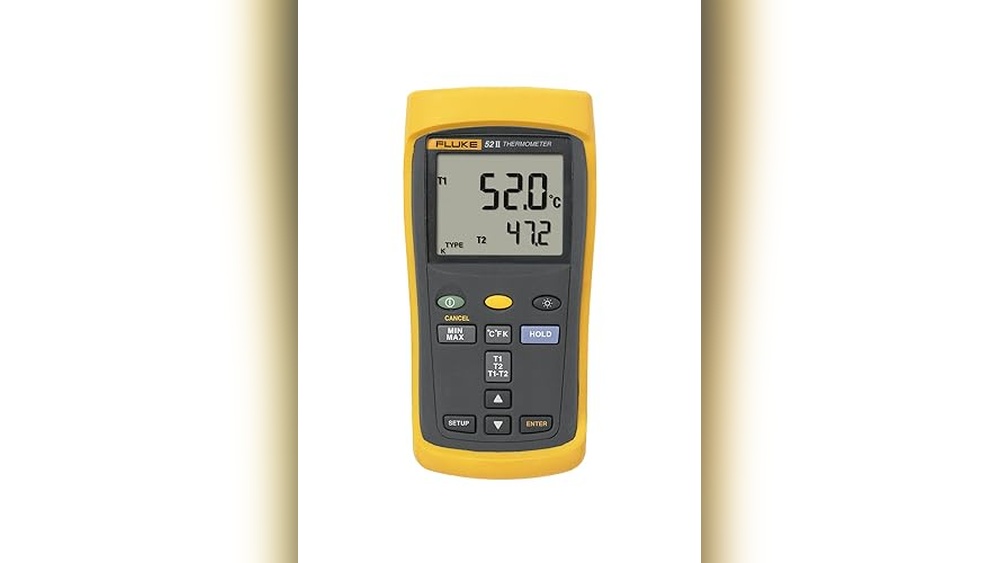
Yes, it covers a wide range from -40 to +260 degrees Celsius (-40 to +500 degrees Fahrenheit) using a Type K thermocouple. It supports Type K, J, T, and E probes, providing flexibility for various industrial applications. The thermometer also tracks minimum, maximum, and average temperatures over time, which is useful for monitoring processes.
Using the Fluke 52 daily feels straightforward. I found it reliable when measuring temperatures in furnaces and freezers. The included Type K bead probe with a 40-inch cable offers enough reach for most tasks. The device is lightweight and compact, making it easy to handle during long work sessions. Its compliance with NIST standards adds confidence in accuracy.

Key strengths for temperature monitoring
- Supports multiple thermocouple types (K, J, T, E)
- Wide temperature range suitable for industrial environments
- Measures and displays min, max, and average temperatures
- Includes a 40-inch Type K bead probe for versatile use
- Compact and lightweight for easy handling
- Meets NIST standards for accuracy and compliance
What to consider before choosing the Fluke 52
- No data logging or memory storage features
- Lacks USB or PC connectivity options
- Display is not backlit, which might affect visibility in low light
- Limited to basic temperature tracking functions
Practical impressions from a daily user
This thermometer suits professionals who need reliable, straightforward temperature readings without extra features. It removes the stress of complicated setups or data management. Beginners will find it easy to use, while experienced users appreciate its solid build and accuracy. A practical tip is to keep the included probe’s cable untangled for easier measurements. In my experience, the Fluke 52 gives peace of mind with consistent results in industrial settings.
Is The Fluke 54 Better For Data Logging And Detailed Analysis?
It depends on your requirements. The Fluke 54 offers data logging of up to 500 points with user-adjustable intervals, which the Fluke 52 lacks. It also has an infrared USB port for exporting data to PC software, making it suitable for detailed temperature analysis. The large backlit dual display shows multiple readings simultaneously, including differences between inputs.
In daily use, I found the Fluke 54 helpful when tracking temperature changes over time. The recall function allows quick review of logged data on the meter itself. It’s slightly heavier than the Fluke 52 but still portable. The battery operation with 3 AA cells is convenient, and the noise rejection feature improves accuracy in electrically noisy environments. These extras make it a solid choice for users needing more than just instant readings.

What makes the Fluke 54 stand out for logging and analysis
- Logs up to 500 data points with adjustable intervals
- Infrared USB port for exporting data to PC software
- Large backlit dual display with multiple readout options
- 60 Hz noise rejection for improved accuracy
- Recall function to review logged data on the device
- Runs on 3 AA batteries for easy replacement
Important factors before selecting the Fluke 54
- Higher price compared to simpler models
- Slightly heavier and larger device
- Requires software for full data analysis capabilities
- May be more complex for users needing only basic readings
How the Fluke 54 fits into professional use
This model suits users who need to track temperature trends over time and analyze data in detail. It reduces the stress of manual record-keeping and allows for better process control. Beginners might find it a bit advanced, but experienced users will value its precision and logging features. I recommend keeping the USB port clean to ensure smooth data transfer. In my experience, the Fluke 54 brings peace of mind with its thorough data management and accuracy.
Key Questions To Decide Between Fluke 52 And 54
Do you need to log temperature data for later analysis, or just immediate readings? Is USB connectivity important for exporting your measurement data? Will you benefit from a backlit display for use in dim environments? How important is a wide temperature range for your applications? Do you want a lightweight, simple device or one with advanced features? Are you comfortable using software tools to analyze temperature data?Comparing Fluke 52 And 54 For Practical Temperature Monitoring
Both devices excel at dual input temperature measurement but differ in data handling and features. The Fluke 52 is straightforward and lightweight, ideal for quick checks. The Fluke 54 adds data logging and USB export, better for detailed analysis. Daily use showed the 54 is more versatile, while the 52 is simpler and faster for basic tasks.Which thermometer handles temperature range better?
Both support wide temperature ranges suitable for industrial use. The Fluke 52 measures from -40 to +260°C (-40 to +500°F) with the included probe. The Fluke 54 covers an even broader range, from -418 to 3212°F, accommodating extreme conditions.| Metric | Fluke 52 Dual Input | Fluke 54 USB Recording |
|---|---|---|
| Temperature Range | -40 to +260°C (-40 to +500°F) | -418 to 3212°F |
| Thermocouple Types | K, J, T, E | K, J, T, E |
| Probe Included | Type K bead probe, 40″ cable | Not specified |
| Compliance | NIST standards | NIST standards |
So what? Choose Fluke 54 if you need extreme temperature coverage; Fluke 52 suffices for common ranges.
How do the data logging capabilities compare?
Fluke 54 supports logging up to 500 data points with adjustable intervals and USB export. Fluke 52 lacks any data logging or memory features.| Decision point | Fluke 52 Dual Input | Fluke 54 USB Recording |
|---|---|---|
| Data Logging | No | Yes, up to 500 points |
| Data Export | No | Infrared USB port |
| Recall Function | No | Yes |
| Software Support | No | FlukeView Forms |
So what? Fluke 54 is best if you want to record and analyze temperature trends.
Which device offers better display and usability?
The Fluke 54 has a large backlit dual display showing multiple readings and min, max, average values. Fluke 52 has a simpler, non-backlit display.| Use case | Fluke 52 Dual Input | Fluke 54 USB Recording |
|---|---|---|
| Display Type | Basic, no backlight | Large, backlit dual display |
| Readout Options | Min, Max, Avg | T1, T2, T1-T2, Min, Max, Avg |
| Visibility in Low Light | Poor | Good |
| Ease of Use | Simple | More advanced |
So what? Fluke 54 improves visibility and versatility for diverse monitoring environments.
How do size and weight affect portability?
Fluke 52 is lighter and slightly smaller, making it easier to carry around. Fluke 54 is a bit bulkier due to added features.| Metric | Fluke 52 Dual Input | Fluke 54 USB Recording |
|---|---|---|
| Weight | 0.66 Pounds | 1.0 Pounds |
| Dimensions (HxWxL) | 2.6 x 9.7 x 6.6 inches | 2.8 x 6.7 x 9.4 inches |
| Battery Type | Not specified | 3 AA batteries |
| Portability | Very portable | Moderately portable |
So what? Fluke 52 is better for users prioritizing lightweight and compact design.
Making The Right Choice Between Fluke 52 And Fluke 54 Thermometers
If you want a reliable, simple, and lightweight dual input thermometer for straightforward temperature checks, the Fluke 52 is a solid pick. It covers common industrial temperature ranges and is easy to operate without added complexity.
For those needing comprehensive data logging, USB connectivity, and a backlit display for detailed temperature analysis, the Fluke 54 is more suitable. It adds useful features for users managing ongoing temperature monitoring and data export.
If you are unsure, consider whether you need data logging and PC export; if not, the Fluke 52 will serve well. Both models deliver accurate measurements, so your choice depends on how much data management you require.
Common Questions About Fluke 52 Vs 54 Digital Thermometers
Can the Fluke 52 and 54 use the same thermocouple probes?
Both support Type K, J, T, and E thermocouples, so probe compatibility is similar. The Fluke 52 includes a Type K bead probe, while the Fluke 54 does not specify included probes. You can use the same probes with either device.
Is data logging necessary for typical industrial temperature monitoring?
Data logging is useful if you need to track temperature changes over time or analyze trends. If you only require instant readings, the Fluke 52’s lack of logging may not be a drawback. Consider your workflow before choosing.
How easy is it to transfer data from the Fluke 54 to a computer?
The Fluke 54 uses an infrared USB port to export data to FlukeView Forms software. The process requires the optional software and a compatible PC, but it allows detailed analysis and graphing of logged temperatures.
What power sources do these thermometers use?
The Fluke 54 runs on 3 AA batteries, which are easy to replace. The Fluke 52’s power source is not explicitly mentioned, but it is lightweight and designed for portability. Battery life varies depending on usage.
Are these thermometers suitable for beginners?
The Fluke 52 is straightforward and beginner-friendly with simple functions. The Fluke 54 offers more advanced features that might require some learning but benefit experienced users. Choose based on your comfort with technology.
Can the Fluke 52 or 54 measure temperatures in extreme environments?
The Fluke 54 supports a wider temperature range, including very high temperatures up to 3212°F. The Fluke 52 covers typical industrial ranges up to 500°F, so select according to your environment’s demands.
What common mistakes do buyers make when choosing between these models?
Many buyers underestimate the importance of data logging and export features, leading to purchasing a simpler model when they need detailed records. Others pay extra for features they won’t use. Assess your needs carefully to avoid mismatches.

I’m Asif Ur Rahman Adib, an Electrical Engineer and lecturer. My journey began in the lab, watching students struggle with instruments they used every day without fully understanding them. Over time, I’ve combined teaching, research, and hands-on experience to help others grasp electrical concepts clearly, safely, and practically—whether it’s understanding a circuit or mastering a multimeter.